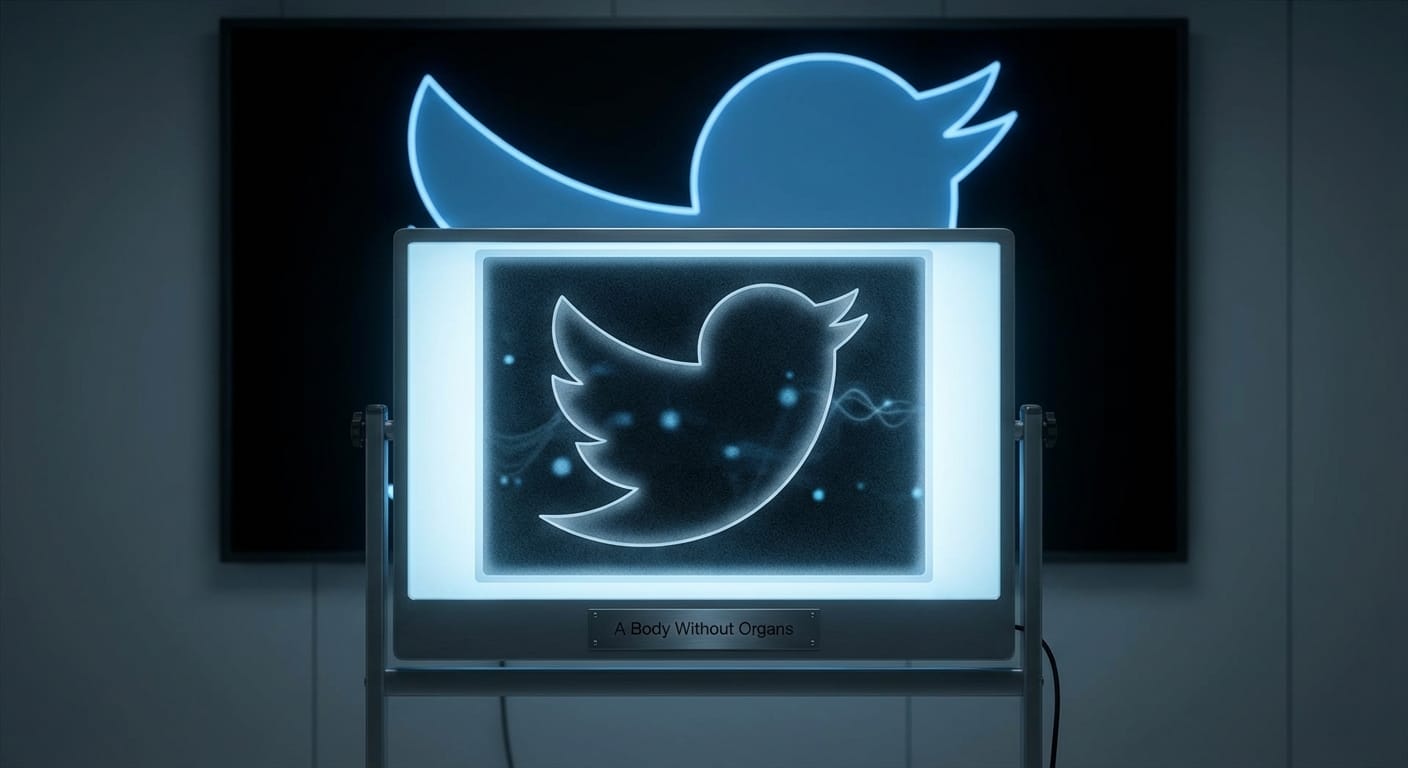
And What That Means for the Future of the Self
The French philosopher Gilles Deleuze warned that there are states of experience you should not enter too quickly.
One of those states is what he called the Body without Organs (BwO): a condition in which the usual structures that stabilize identity—roles, habits, hierarchies, temporal rhythms—are stripped away, leaving a field of raw intensity, connection, and possibility. The BwO is not evil. It can be creative, revelatory, even liberating. But it is also dangerous. Entered without preparation or grounding, it can lead to collapse, paranoia, or self-erasure.
Deleuze was writing decades before social media. But Twitter has quietly become the first global, always-on BwO, available to anyone with an internet connection, instantly and without initiation.
That fact matters more than we’re ready to admit.
1. What Makes Twitter a BwO
Twitter removes friction at every level.
It collapses:
- Social hierarchy (anyone can reply to anyone)
- Temporal sequencing (old posts coexist with new ones)
- Context (statements circulate detached from origin or intent)
- Embodiment (no physical cues, no shared environment)
What remains is pure signal:
- Attention
- Status
- Affect
- Pattern recognition
- Feedback
This is precisely what Deleuze meant by a BwO: a space where intensities circulate without the organs—institutions, roles, pacing mechanisms—that normally regulate them.
In earlier eras, entering such a space required years of philosophical training, spiritual discipline, or artistic immersion. Today, it takes creating an account.
2. The Immediate Risk: Identity Without Scaffolding
The self is not a static object. It is a dynamic equilibrium maintained by routines, relationships, and slow feedback loops. Twitter removes those stabilizers immediately.
For people with strong grounding—offline identity, slow feedback, trusted peers—this can be exhilarating. For others, it is overwhelming.
Deleuze predicted two major failure modes when someone enters a BwO too fast:
- Dissolution
Loss of coherence, paranoia, runaway pattern projection. - Crystallization
The self hardens into a rigid form as a defense mechanism.
Twitter massively selects for the second.
3. Crystallization as Armor
When exposed to constant evaluation, contradiction, and context collapse, many people respond by freezing their identity.
They become:
- A stance
- A brand
- A fixed ideological position
- A repeatable set of takes
This crystallized self is not chosen freely. It is adopted as armor.
A rigid identity is easier to defend than a fluid one. Repetition feels safer than exploration. Predictability reduces threat.
But this has a paradoxical effect.
4. High Felt Change, Low Actual Change
Twitter creates the experience of rapid change:
- Constant novelty
- Emotional volatility
- Status fluctuations
- Algorithmic amplification
Subjectively, it feels like everything is moving fast.
Objectively, many people are not changing at all.
They repeat the same positions.
They reinforce the same identity.
They narrow, rather than expand, their action space.
This produces high felt rate of change with a low actual rate of change—motion without development. A perfect outcome for a control system.
5. Why the Platform Rewards This
From a systems perspective, crystallized selves are easier to manage.
They:
- Produce consistent signals
- Fit neatly into clusters
- Are easier to predict, model, and monetize
Fluid, exploratory selves are harder to capture. They resist stable categorization. They change slowly and off-cycle.
So while Twitter appears to celebrate disruption and novelty, it structurally rewards identity hardening.
The platform creates a BwO—and then selects for whatever keeps users intact just long enough to keep producing data.
6. The Broader Implication: A Civilization Without Pacing
This is not just about Twitter.
We are building environments that expose human cognition to unmediated intensity faster than our stabilizing institutions can adapt. The result is not collective enlightenment, but widespread defensive rigidity.
People mistake reactivity for transformation.
Volatility for growth.
Visibility for agency.
The danger is not that everyone loses their sense of self.
The danger is that millions lock into brittle versions of themselves too early—and mistake that rigidity for strength.
7. What the Future Demands
If Twitter is a global BwO, then the question is not whether people will enter it—but whether we will build pacing, grounding, and feedback mechanisms that allow them to leave intact.
The future will belong to systems that:
- Slow perception without dulling insight
- Encourage reversible identity
- Distinguish real change from simulated volatility
- Treat human coherence as something worth protecting
Freedom without structure is not liberation.
It is exposure.
And exposure without care does not create growth—it creates armor.
Closing Thought
Twitter doesn’t destroy selves directly.
It removes stabilizers too quickly—and then rewards whatever rigidity keeps the system running.
The question facing us now is whether we continue to mistake intensity for progress, or finally learn how to design spaces where people can see clearly without losing themselves.