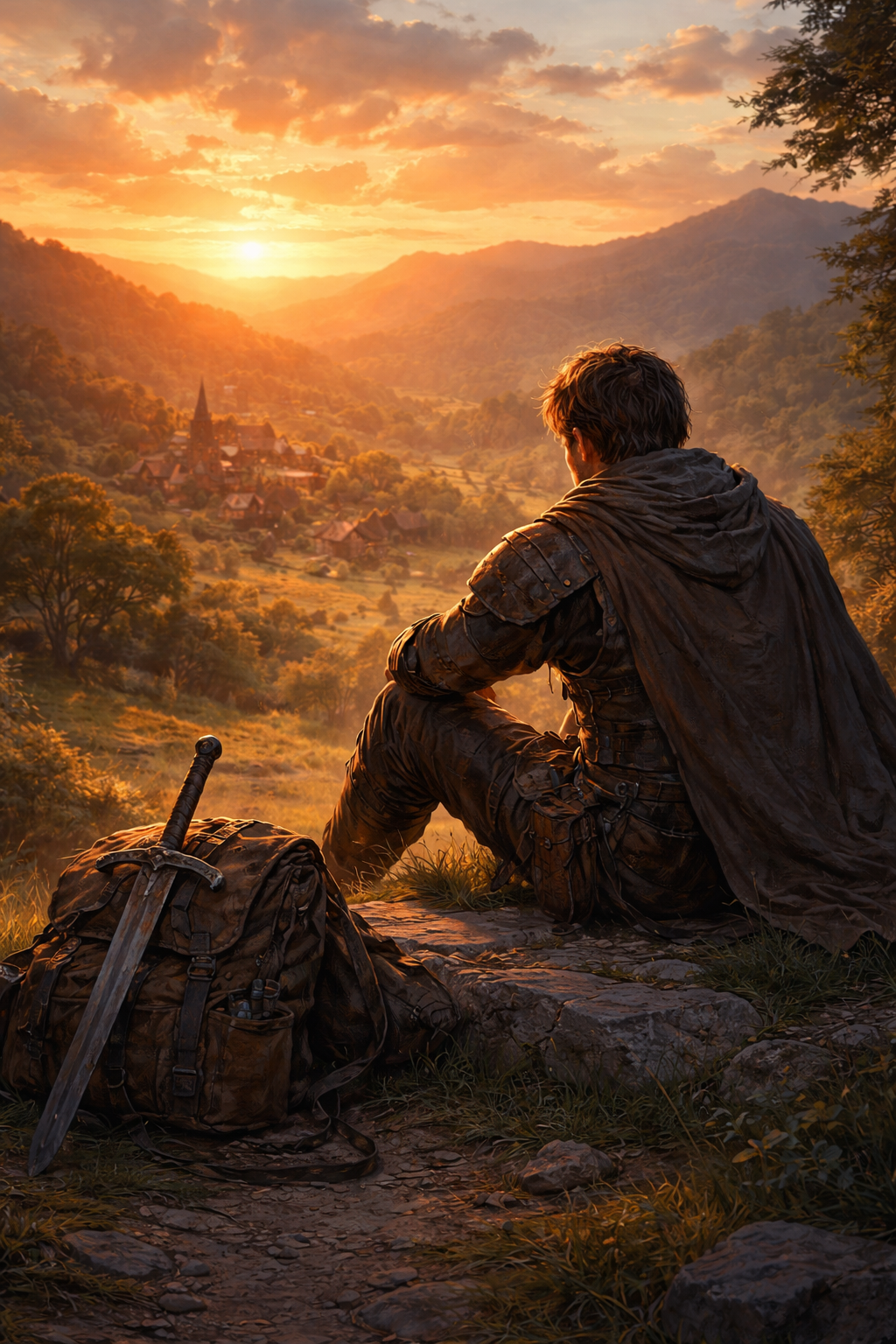
We are taught to admire players.
The explorers.
The builders.
The ones chasing the next achievement, the next frontier, the next unlock.
But worlds are not sustained by players.
They are sustained by those who stop playing.
A world only exists if someone stays
A world is not a map.
It is not content.
It is not possibility.
A world is what remains when novelty runs out.
Shops open because someone opens them every day.
Paths exist because someone walks them repeatedly.
Meaning persists because someone remembers it long after the excitement fades.
These are not side characters.
They are the load-bearing structures of reality.
Without NPCs—without people who stay—the world collapses into a sandbox with no memory.
The lie of infinite exploration
Modern culture worships exploration.
Explore yourself.
Explore the market.
Explore the unknown.
But endless exploration is not freedom.
It is often avoidance.
If you never stop exploring, you never have to commit.
If you never commit, you never have to face the consequences of staying.
If you never stay, you never have to meet yourself without motion as a shield.
The great unknown can become a hiding place.
There is a point where exploration stops being courage and starts being flight.
Growth has a stopping point
Every real game has an end condition.
Not because growth ends—but because unbounded growth destabilizes the world.
A player who never stabilizes:
- Consumes coherence without replenishing it
- Extracts meaning without maintaining it
- Leaves behind fragments instead of foundations
At some point, growth requires choosing:
- Where you will stay
- What you will maintain
- Which part of the world you are willing to shrink so others can stand on it
This is not regression.
This is maturation.
NPChood as a conscious choice
An NPC is not someone who failed to become a hero.
An NPC is someone who finished their arc.
They have:
- Collapsed enough uncertainty
- Learned the terrain well enough
- Accepted enough limits
And instead of restarting the game, they remain.
They hold context.
They carry memory.
They offer quests that matter because they understand the cost of learning firsthand.
NPCs do not give random tasks.
They give distilled experience.
The hidden goal of every great game
The true goal of a good game is not to trap you.
It is to prepare you to leave.
A great game teaches you:
- How systems work
- Where power corrupts
- How cooperation scales
- When growth becomes destructive
And then, quietly, it lets go.
The failure mode is not quitting the game.
The failure mode is being unable to stop playing.
Shrinking your slice of the world
Peace is not found by expanding forever.
Peace comes when you decide:
“This is the part of the world I will make smaller so others can grow.”
You stop optimizing.
You stop ranking.
You stop chasing novelty as identity.
You tend a place.
You mentor players.
You hold reality steady long enough for someone else to take a risk.
This is not resignation.
It is responsibility.
Giving up the game
The ultimate peace is not winning.
It is no longer needing to play.
When you can:
- Live without scorekeeping
- Help without extraction
- Teach without needing credit
- Stay without stagnating
You have not lost the game.
You have completed it.
The quiet future
The future will not belong to the loudest players.
It will not belong to infinite explorers.
It will not belong to those who mistake motion for meaning.
The future will belong to NPCs:
- The ones who stayed
- The ones who remembered
- The ones who held the world together while others were busy becoming themselves
Because eventually, every healthy system needs fewer heroes—
and more people who know when to stop playing
and start living.