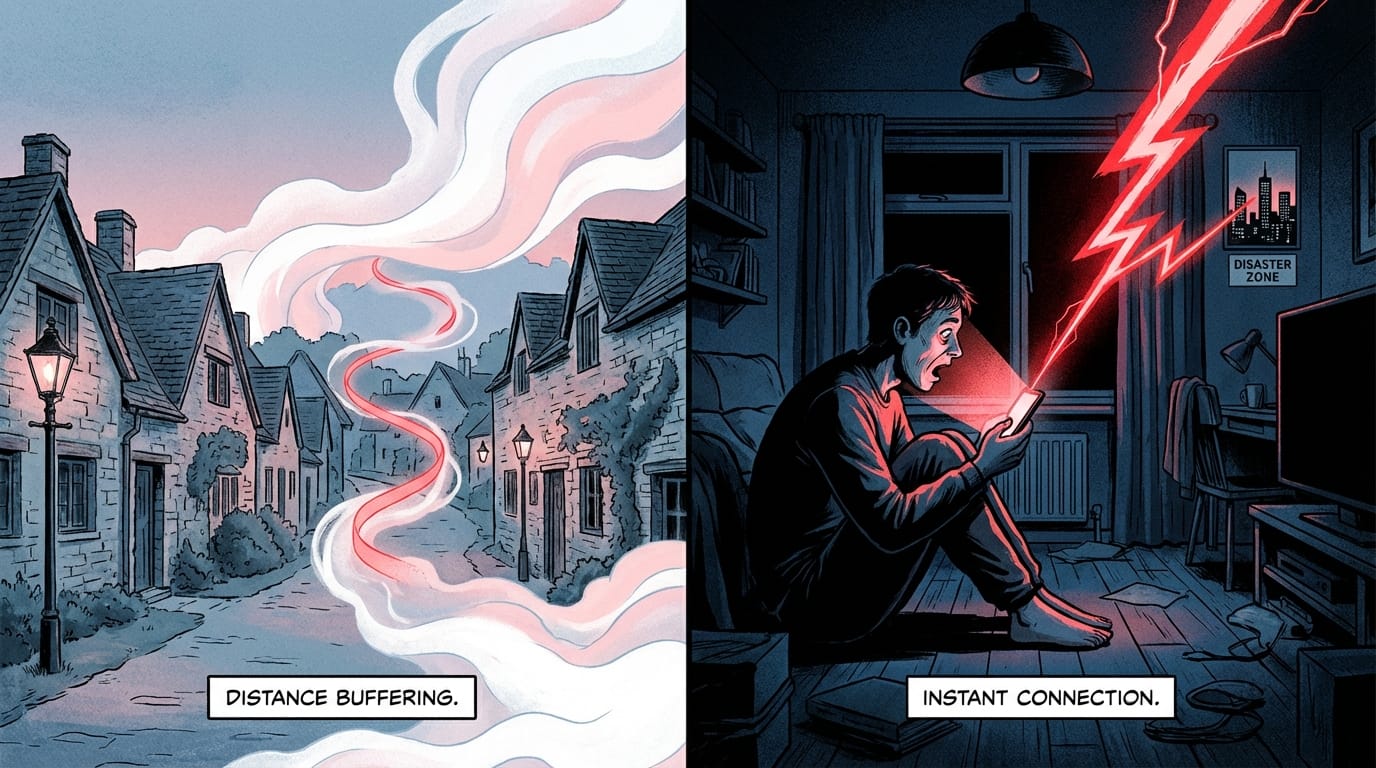
Why "The Truth" isn't always the antidote to anxiety, and how the internet broke the physics of human gossip.
We have a standard narrative about the Information Age: Gossip is bad. Truth is good.
The logic goes like this: In the old days, rumors spread like a game of "Telephone." By the time the news reached the next village, it was distorted, exaggerated, and unreliable. Today, thanks to the internet, we can "verify" anything instantly. We can check the source. We can see the video. We can access the dashboard. Therefore, we should be calmer and more rational.
I built a Python simulation to prove this. I created a network of conscious agents, traumatized one of them, and watched how the panic spread.
I expected the "Fact-Checking" network to be the stable one.
I was wrong. The network with access to the raw truth didn't calm down. It entered a state of synchronized panic.
Here is what the code taught me about the mechanics of Doomscrolling.
The Experiment: The Village vs. The Feed
I set up a linear chain of agents (A ↔ B ↔ C ↔ D ↔ E ↔ F).
- The Event: Agent A gets hit with a massive "Trauma Shock."
- The Reaction: Agent A goes "numb" (dissociates) and radiates anxiety.
I ran the world two ways:
- The Echo Chamber (The Old World): Agents could only talk to their direct neighbors. Information had to travel hop-by-hop.
- The Open Society (The Internet): Agents still gossiped, but 20% of the time, upon hearing a rumor, they could "Verify" it by instantly checking the state of Agent A directly.
The Result: The Wormhole of Trauma
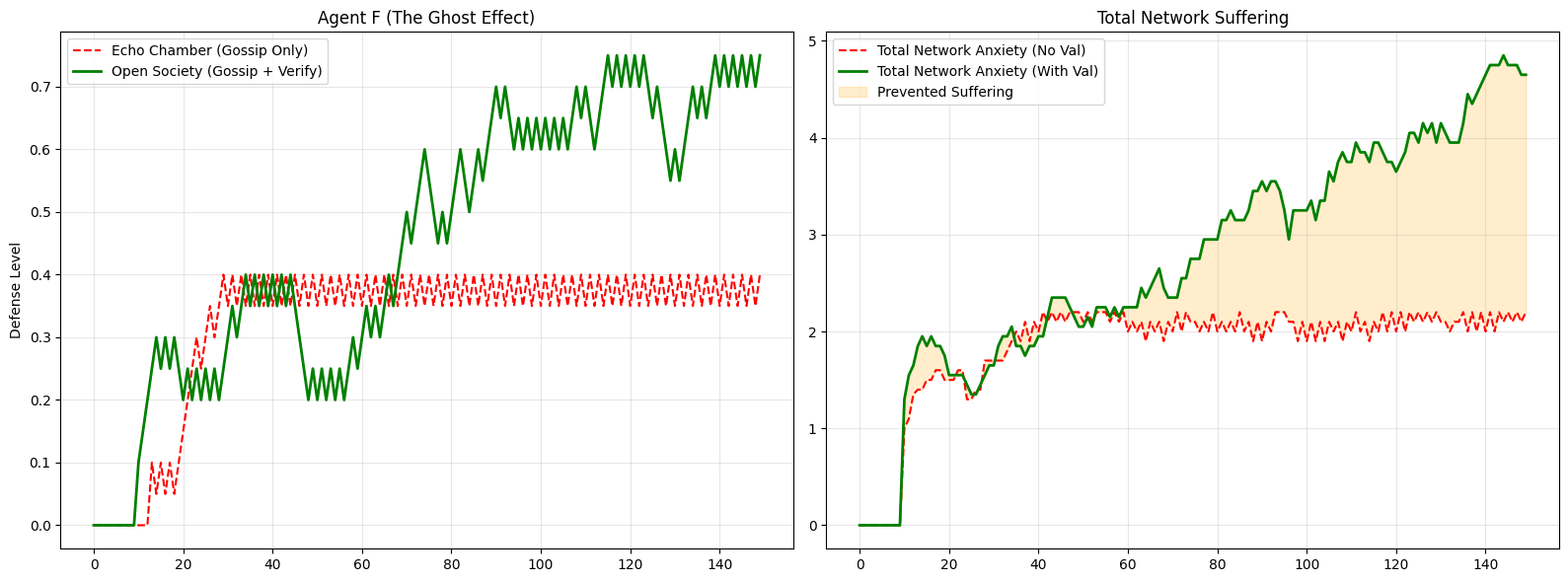
In the Echo Chamber, the panic wave behaved like a physical ripple. As Agent A told B, and B told C, the signal degraded. The "Trust Factor" between neighbors acted as a dampener. By the time the rumor reached Agent F (the furthest away), it was just a whisper. Agent F stayed relatively calm.
In the Open Society, something broke.
When Agent F heard a rumor, they didn't just listen to their neighbor. They "clicked the link." They verified the source.
By doing so, they opened a wormhole directly to Agent A’s trauma. They bypassed the social buffer. They saw the raw, high-intensity shock without the dilution of distance.
The graph was shocking: The "Verified" network experienced 62.5% more peak anxiety than the rumor mill.
Why Negative Effects are Amplified
This simulation reveals a terrifying dynamic of networked consciousness: Transparency removes the immune system of the collective.
In biological networks, distance is a feature, not a bug. If a wolf attacks a sheep on the edge of the flock, the sheep on the other side shouldn't feel the full visceral terror of the attack. They should receive a diluted signal: "Danger over there." This allows the group to remain functional.
Verification destroys distance. It allows high-salience signals (Trauma, War, Disaster) to travel at the speed of light, with zero signal degradation.
- Gossip: "I heard it's bad over there." (Anxiety = 30%)
- Verification: Watches 4K video of the event. (Anxiety = 100%)
The "Truth" acts as a contagion vector. By verifying the facts, the agents synchronized their trauma states.
Why Positive Effects are Dampened
You might ask: "But doesn't verification also show the good news? When Agent A heals, shouldn't the network relax faster?"
The simulation showed the opposite, due to Salience.
We programmed the agents to prioritize talking about danger. (Evolutionarily, it pays to talk about the tiger, not the sunset).
- The Negative Loop: Fear triggers gossip. Gossip triggers verification. Verification confirms the horror. Anxiety spikes.
- The Positive Lag: Safety is boring. When Agent A heals, the "news" becomes less salient. The agents don't feel the urgent need to "verify" that everything is okay.
So, the Trauma travels via the Wormhole (Verification), jumping instantly across the network.
But Safety travels via Diffusion (Gossip), moving slowly, hop-by-hop, and getting diluted along the way.
The result is a network that instantly synchronizes on pain but struggles to synchronize on healing.
The Lesson: We Need Buffers
We usually blame "Fake News" for our collective anxiety. My model suggests that "Raw News" is just as dangerous to a conscious system.
We are living in the "Green Line" of my simulation. We are Agent F, sitting safe in our living rooms, physically untouched. But because we have a supercomputer in our pocket that allows us to "verify" the trauma of the world instantly, our internal defense mechanisms are spiking as if we are standing at Ground Zero.
We have engineered a society that creates Empathy Without Buffer.
The solution isn't to hide the truth. But mathematically, we need to recognize that Latency and Distance were not just technological limitations of the past—they were the insulation that kept the human hive mind from overheating.
Without them, we are just a single nervous system, screaming in unison.